
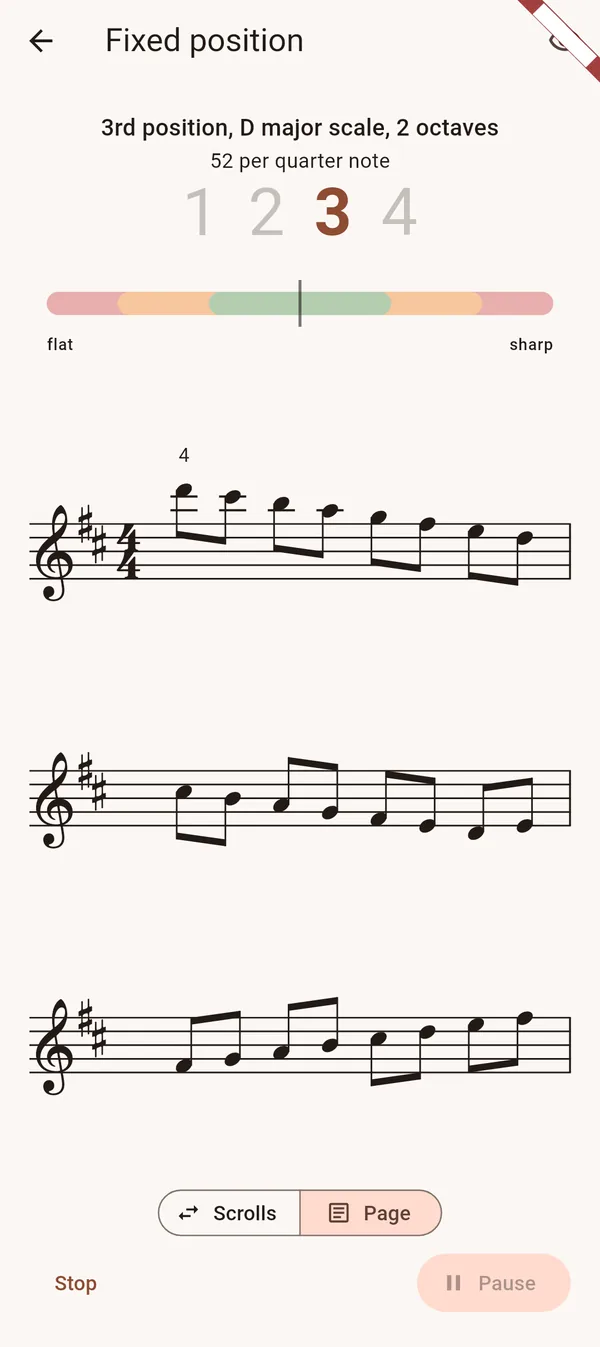
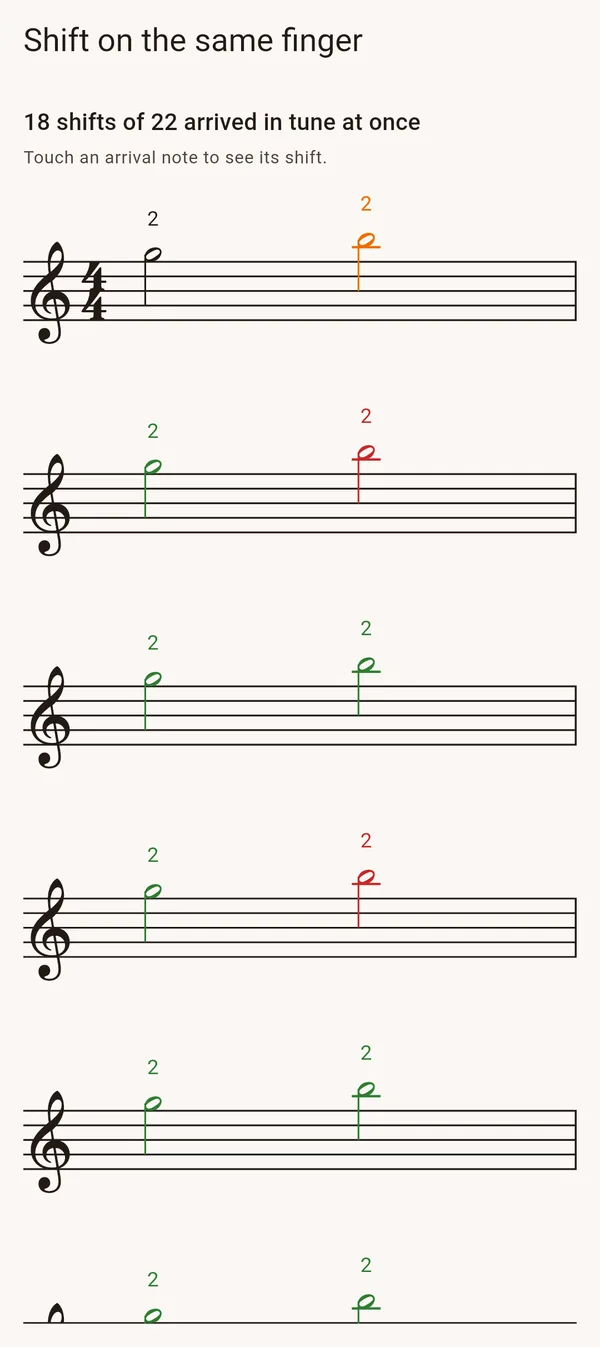
While you play, then after
While you play, a gauge shows the distance between the note you play and the note in tune. When the series ends, every note of the score takes a colour: green if it is in tune, orange if it is a little off, red if it is out of tune. Touch a note to see its distance in cents, and whether you corrected it.
The reference a violinist uses
A tuner measures each note in equal temperament, the tuning of the piano. A violinist does not always play that way: in a double stop a major third sits about 14 cents lower than on a piano, and in a scale the leading note leans up towards its tonic. Avilo judges each exercise against the reference that suits it.
- Double stops: judged against pure intervals (thirds, sixths, octaves)
- Scales: melodic intonation is accepted
- Your own scores: note by note, with the same rules
A tolerance for your level
A note is in tune within ±30 cents for a beginner, ±18 for an intermediate player and ±12 for an advanced one, from published measurements of violinists. A series is good when 70, 75 or 80 % of its notes are in tune, depending on your level.
Exercises built for intonation
- Finger patterns: where the half steps fall, string by string
- Each finger alone first, then the half steps, the extensions and the low first finger
- Scales in the keys you know, then in positions
- Thirds, sixths and octaves, broken then held
Read the guide: How to improve your violin intonation