
Know your finger patterns
In first position, the fingers take a few patterns, depending on where the half step falls. Ševčík built his beginner's method on them, the system of half steps. Learn each one on its own, slowly, on all four strings:
- 2 and 3 together: the pattern of A major on the A string, usually learnt first
- 1 and 2 together: C natural on the A string, as in G major on the E string
- 3 and 4 together: the half step at the top of the hand
- Low first finger: the first finger back towards the nut, as for B flat on the A string
Check against the open strings
Open strings are your reference. The fourth finger plays the note of the next open string: compare them (Ševčík op. 6 no. 4). G, D and A played with a finger ring with the open strings when they are in tune: you hear it in the violin.
Keep the fingers down
A finger that stays on the string is a landmark for the next one. Play patterns where the fingers stay down while the others move (Ševčík op. 6 no. 12, Schradieck book 1). The hand keeps its shape and the fingers land in the same place.
Slow scales, long notes
Play a scale slowly, one long note per bow, and listen to each step before going on. Correct the note while it sounds, then play it again in tune. Then faster, in eighths, in dotted rhythms, in triplets (Hřímalý): if the intonation breaks, go back to the tempo where it held.
Use the right reference
A violinist does not play in equal temperament everywhere. In a scale, the leading note leans up towards its tonic; in a double stop, a major third sits about 14 cents lower than on a piano. A tuner judges every note against equal temperament: use it to check a note, not a melody.
Beginners stray about 20 cents in scales on average, professionals about 10 in very slow scales (Pardue and McPherson, 2019; Loosen, 1993). Aim for the tolerance of your level first.
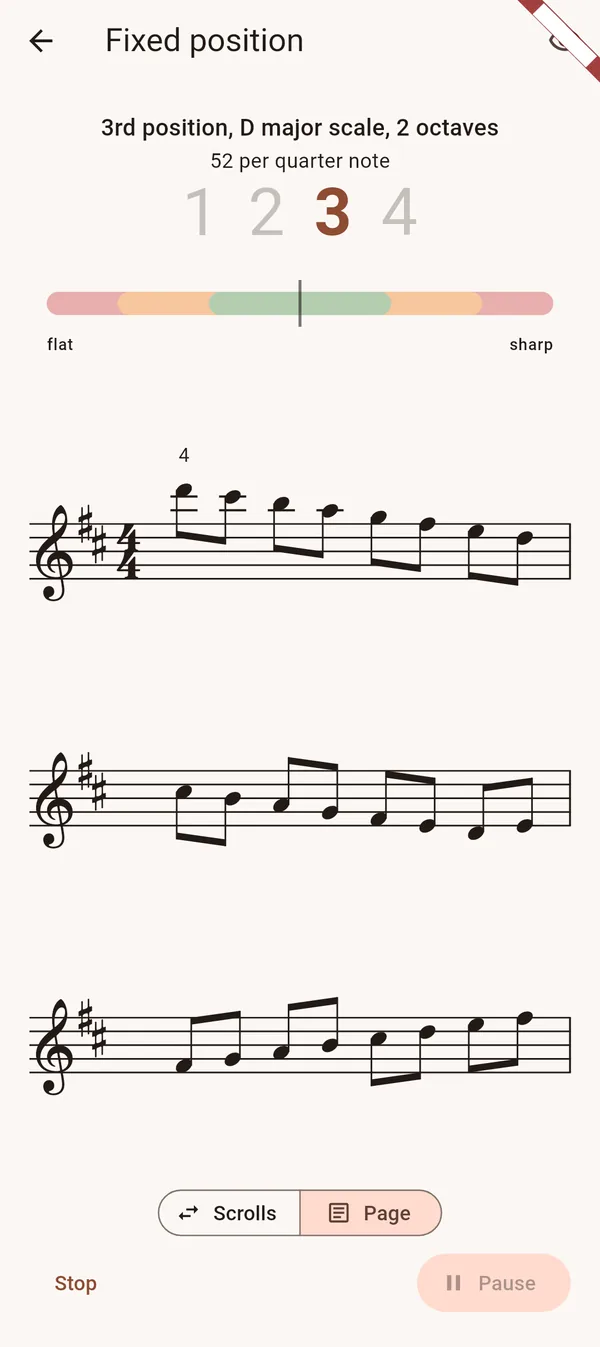
Look less, listen more
Looking at a screen during the note helps to find a placement, but does not train the ear. Look once, then play again without looking. After the series, look at which notes are out of tune, and whether they tend to be sharp or flat.