
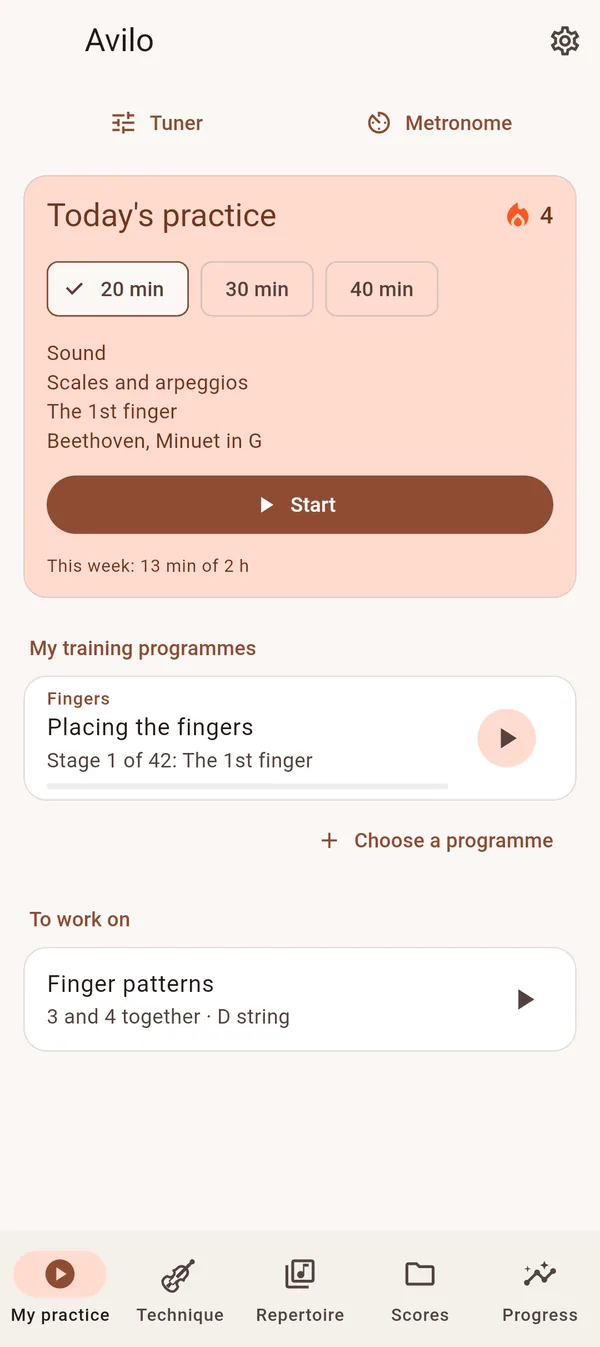
The order of a session
- The sound: long bows on open strings, even from frog to tip, to warm up the bow arm and the ear
- A scale in a key you are learning, slowly, then in rhythms
- The new gesture: one difficulty at a time, a new position, a stroke, a rhythm
- A review: what you learnt last week, so it stays
- Music: a tune, a study or your piece, played through
Sample routines
| Length | What goes in |
|---|---|
| 20 minutes | Sound 3 min, scale 4 min, new gesture 8 min, music 5 min |
| 30 minutes | Sound 4 min, scale 5 min, new gesture 10 min, review 4 min, music 7 min |
| 40 minutes | Sound 5 min, scale 6 min, two gestures 15 min, review 5 min, music 9 min |
Twenty minutes every day are better than two hours on Sunday.
One difficulty per exercise
An exercise that asks for a new rhythm, a new position and a new stroke at once teaches you none of the three. Take one, keep everything else easy, and add the next only when the first holds.
Slow, then faster
Start a new exercise below its tempo and raise it a little after each clean series. Avilo starts at 70 % of the target for a beginner and 85 % for an intermediate player, and climbs series after series.
Review, and come back to what went wrong
You forget what you do not play again. Review what you learnt every few days. And when an exercise went badly, play it again the next day, not in a month.
Practise quietly
A practice mute lets you play late or in a flat without disturbing anyone. The sound is very different, so keep some practice without it to hear your real tone.