
When to start
Vibrato needs a left hand already sure of its notes. Start once the finger patterns in first position are secure and third position is familiar: Avilo puts it at the intermediate level, as most teachers do.
The slow motion, counted
Start on the second finger in first position, a long note, with a metronome. Make two even oscillations per beat, slow and wide, the finger rolling on its pad. Then three, then four per beat. Counting keeps the motion regular, and you should be able to go back to the slow motion at any time.
Every finger, then third position
- The third finger, then the first: the first is often the hardest
- In third position: the hand rests against the body of the violin, which helps many players
- The fourth finger last, at the advanced level
A continuous vibrato
A vibrato that stops at each new note breaks up the phrase. Keep the motion going from one finger to the next, then from one string to the next, then on quarter notes and on a scale.
Speed, width and expression
- Six oscillations per beat at the advanced level
- From the attack: the vibrato starts with the note, not after it
- Right after a shift: the arrival note vibrated at once
- Narrow and fast, or wide and slow, as the music asks
- In music: a slow tune
This order is the one Galamian and Flesch share with most teachers.
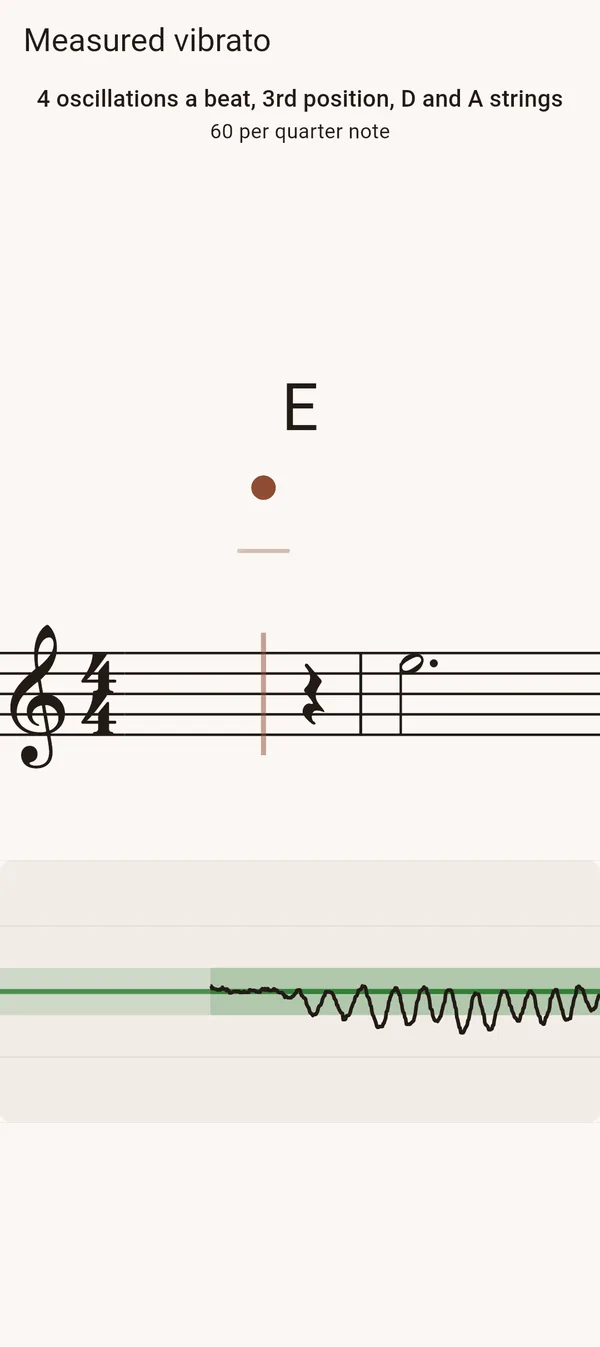
What to listen for
- An uneven motion: some oscillations wider than others. Slow down, count again
- A vibrato that stops between notes or at the bow change
- A tight hand: the thumb squeezes, the motion gets small and fast. Release the thumb
Questions
How long does it take to learn violin vibrato?
It varies a lot. The slow, counted motion can come in a few weeks of short daily practice; an even, continuous vibrato in music usually takes months.
Should violin vibrato come from the wrist or the arm?
Both exist, and many players mix them. Choose with a teacher who can see your hand; the exercises above work for both.
How fast should vibrato be?
Practise at a counted speed first: two, then three, four and six oscillations per beat at the metronome. In music, the speed and width follow the character of the phrase.